For project developers
Screen your candidate sites before you spend the design budget
A desktop ARR feasibility study for carbon project developers: the eligible area, the Tier 1 carbon case and the net figure after deductions, on one method for every site in your pipeline. From $500, in days, following VM0047.
The screening problem every developer has
A developer usually has more candidate sites than design budget. Landowners, cooperatives and governments offer land; some of it was forest a few years ago, some sits on steep hills, some is farmed so intensively that leakage eats most of the credits. Finding that out through a field visit or a full project design costs weeks and real money per site.
A desktop screen answers the first questions for each site at a fixed price: how much of the land can be counted, how fast trees grow there by the IPCC defaults, and what is left after the deductions a registry will make. You spend the field and design budget on the sites that survive. The carbon feasibility study guide explains each part of the report.
- Eligibility Check$500 · 2–3 days
- Full study$7,500 · 5 days
- ScopeARR and agroforestry (VM0047)
- ReviewEvery report, by a specialist
How it works for a developer
Upload each site
On app.feasibility.earth, add the boundary as KML or KMZ, the role of each area (planting, agroforestry, preservation or reference), species if you know them and a start year. About 15 minutes per site.
Method check before payment
You are told before you pay whether the project is tree planting on land without forest. REDD+, forest management, blue carbon and soil carbon are out of scope for now.
Triage with the Eligibility Check
For $500 a site, get the eligible area, the main barriers and a proceed-or-stop recommendation in 2–3 business days. Use it on sites you have not walked or that sit near forest.
Full study on the shortlist
For the sites worth pursuing, the $7,500 study adds climate and terrain, a species screen, carbon removals over 40 years in three cases and the gross-to-net table, in 5 business days.
Decide and move on
The recommendation lists the work still needed: land rights, consent, field data, the project design document. That list becomes your next budget.
What 17 real screenings showed
Across the 17 distinct sites we have screened, the median eligible share was 40.7%. The range ran from over 99% on a large savanna landscape to 0.1% on a Cameroon mangrove site. Six of the 17 sites were under 11% eligible, and every one of them had at least 66% of its area classed as forest in 2000. Every site with 9% or less forest in 2000 came out at least 90% eligible.
For a developer, that means one layer, the forest-cover history, separates most viable sites from the rest, and it is cheap to check before anything else. Growth rates then spread the carbon case: the IPCC Tier 1 above-ground rates we used ranged from 0.775 tCO2e/ha/yr for young stands in tropical shrublands to 13.097 in African tropical rainforest, more than a fifteen-fold spread in the first 20 years. Read what 17 desktop screenings show for the full table, or the country guides for one study per country.
| Kenya, dryland highlands | Colombia, Llanos pasture | |
|---|---|---|
| Site | about 1,700 ha | about 1,190 ha |
| Eligible | 94.7% | 90.7% |
| IPCC zone, rate ≤20 yr | Tropical shrublands, 0.775 | Tropical rainforest (Americas), 10.168 |
| Gross removals | about 69,800 tCO2e | about 372,500 tCO2e |
| Leakage in the screening | about 55,300 (79% of gross) | about 209,200 (56% of gross) |
Both sites were almost fully eligible. Per hectare, the climate made the Colombian carbon case about eight times the Kenyan one (about 345 against 43 tCO2e over 40 years), and in both the leakage line, driven by the grazing the trees would displace, was the biggest deduction.
Gross to net, early
Investors and buyers ask for net credits, not gross. The full study deducts uncertainty, a non-permanence buffer and leakage from the gross figure. In the anonymised sample study, a tree-planting project on dry bushland in East Africa, 1,608 eligible ha gave 69,779 tCO2e gross over 40 years (average case) and a net screening estimate of −2,976 tCO2e. Leakage alone was 55,310 tCO2e, 79% of gross, because the order form did not say how the land is used today. Telling the study that is the cheapest way to a better net figure.
The screening applies the 10% uncertainty deduction VM0047 requires as a minimum for ex-ante estimates, and a 15% buffer, the median of 198 registered ARR projects in our registry data. The real buffer comes from the VCS AFOLU Non-Permanence Risk Tool at validation. The single answer that moves net credits most on farmed land is what the land is used for today and where that use goes, so give it in the intake. See gross vs net carbon credits.
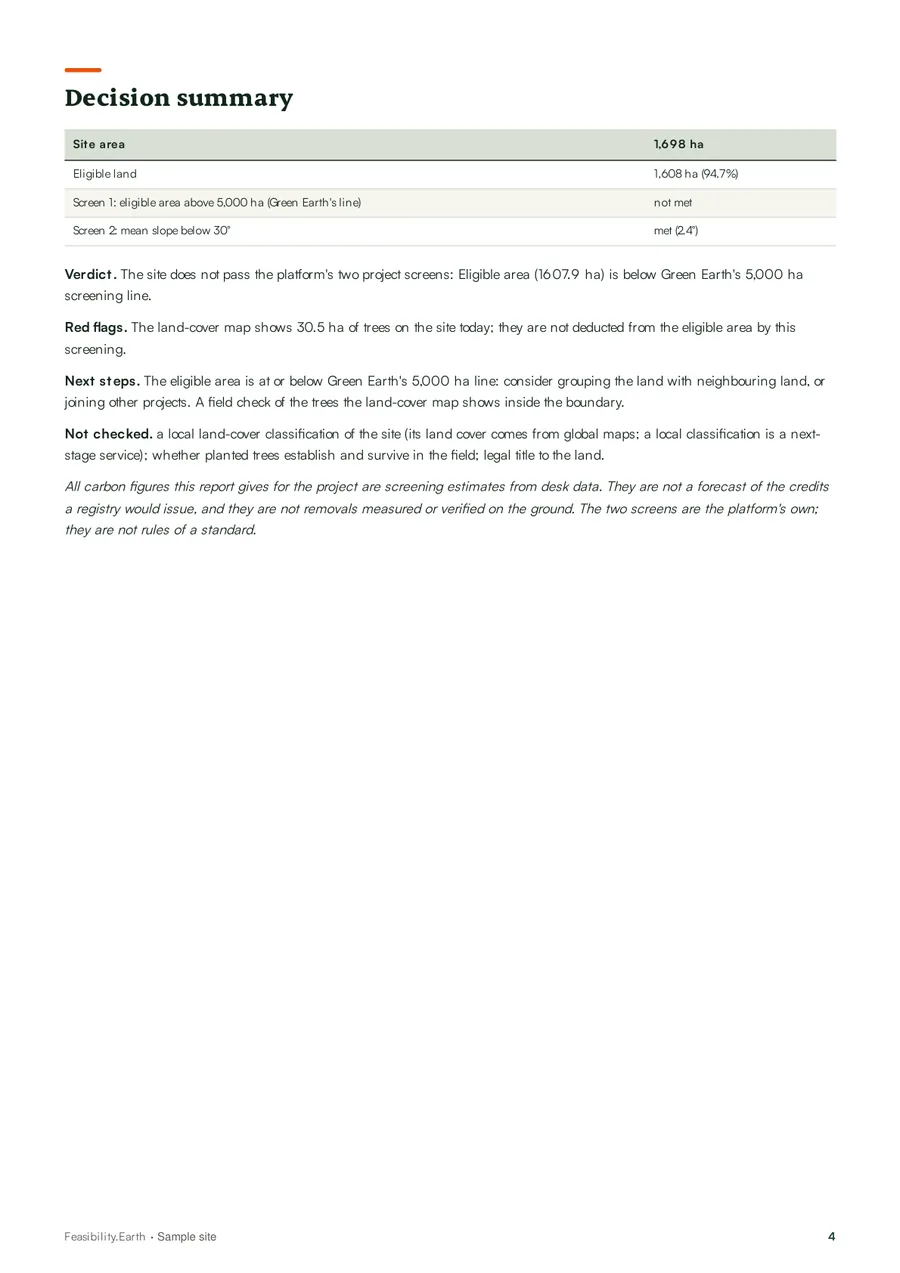 Decision summaryBoth screens, red flags and next steps on one page
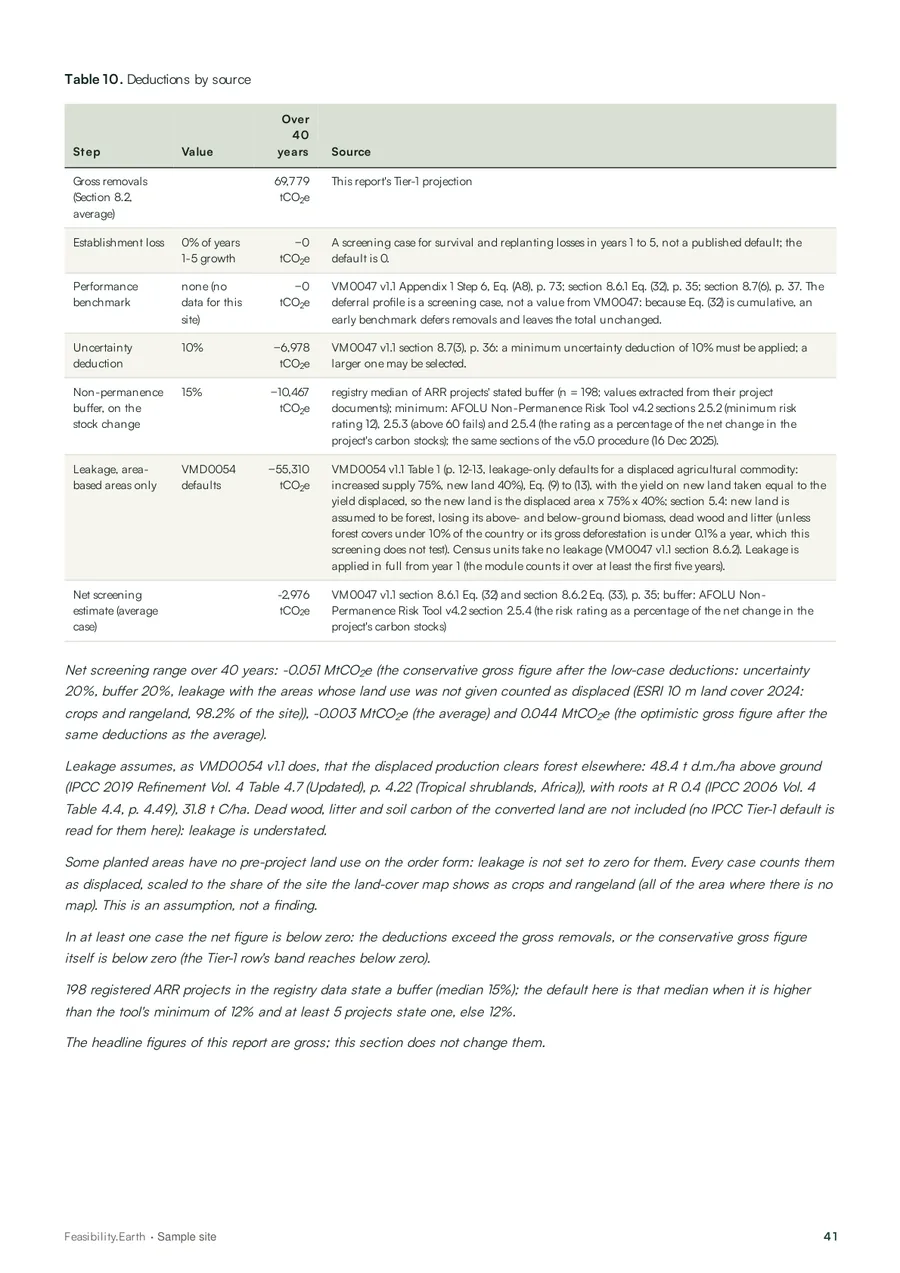 Gross to netEvery deduction with its source
How developer teams use the report
- Pipeline triage. Run the Eligibility Check across a list of offered sites and drop the ones where most of the land was forest or recently cleared.
- Site selection. Compare shortlisted sites on the same eligible-area, growth-rate and gross-to-net basis before committing field teams.
- Investor conversations. Share a reviewed document that shows gross and net side by side, with every dataset and assumption named. It supports a conversation; it does not replace an investor's own due diligence.
- Project design. The eligible-area map, species shortlist and deduction table are inputs to the project design document.
Partnering with Green Earth Group, and refunds
For projects that pass the full study, Green Earth Group offers project-development support and, case by case, considers co-investment. If Green Earth Group partners with the project for development, the study fee is refunded. That is decided per project after the study, and it is never promised up front. See carbon project development for the stages a partner would cover.
If the completed full study concludes that the land does not qualify, 50% of the fee is refunded. The Eligibility Check is not refundable once work starts. Full terms are on the pricing page.
What a desktop screen does not settle
Frequently asked questions
The Eligibility Check ($500) is delivered in 2–3 business days and the Full Feasibility Study ($7,500) in 5 business days, both counted from a complete intake. The intake takes about 15 minutes per site: a KML or KMZ boundary, the role of each area, species if known and a start year.
Yes. Every study runs the same datasets (Hansen Global Forest Change, GHSL, JRC Global Surface Water, NASADEM), the same IPCC 2019 Refinement Tier 1 growth rates and the same gross-to-net steps, and specialists review every report before release. Sites can be compared on one basis.
A desktop screening of a tree-planting project (afforestation, reforestation and revegetation, including agroforestry) following Verra's VM0047 methodology. It covers the method check, eligible area, climate and terrain, a species screen, 40-year carbon removals in three cases, gross to net and a recommendation. It is not a validation or a credit forecast.
For projects that pass the full study, Green Earth Group offers project-development support and, case by case, considers co-investment. If Green Earth Group partners with the project for development, the study fee is refunded. A partnership is never automatic or promised; it is decided per project after the study.
If the completed full study concludes that the land does not qualify, 50% of the $7,500 fee is refunded. The $500 Eligibility Check is not refunded once work starts; the written answer is what you pay for.