Guide · Carbon accounting
Gross vs net carbon credits: what comes off before you can sell
A tree-planting project's gross removals are not its credits. The baseline, leakage, uncertainty and the non-permanence buffer come off first, and on some sites they take most of it. This guide explains each deduction under VM0047, with the real numbers from an anonymised study.
Why the difference matters
Business plans for tree-planting projects are often built on a gross figure: hectares times a growth rate times years. Investors and buyers look at the net. The gap between the two decides whether a project pays for itself, and it varies far more between sites than growth rates do.
Under VM0047, the methodology for afforestation, reforestation and revegetation (ARR), four things separate gross from net: the baseline, leakage, an uncertainty deduction and the non-permanence buffer. A fifth factor, timing, decides when the net arrives.
A real example
This is the deduction table from a real Feasibility.Earth study of a tree-planting project on dry bushland in East Africa, anonymised. Over 40 years, 69,779 tCO2e of gross removals became −2,976 tCO2e net: the deductions were larger than the removals, so the average case ends below zero. The report's net screening range runs from −0.051 to 0.044 million tCO2e (conservative to optimistic), so even the optimistic case stays far below the gross figure.
| Line | tCO2e | % of gross | Basis |
|---|---|---|---|
| Gross removals | 69,779 | 100% | IPCC Tier 1 projection, average case |
| Uncertainty deduction | −6,978 | −10% | 10%, the VM0047 minimum for ex-ante estimates |
| Non-permanence buffer | −10,467 | −15% | 15%, registry median of ARR projects |
| Leakage | −55,310 | −79% | VMD0054 defaults; land use not given, so the mapped crop and rangeland share counts as displaced |
| Net screening estimate | −2,976 | −4% | over 40 years, average case, on 1,608 ha of eligible land |
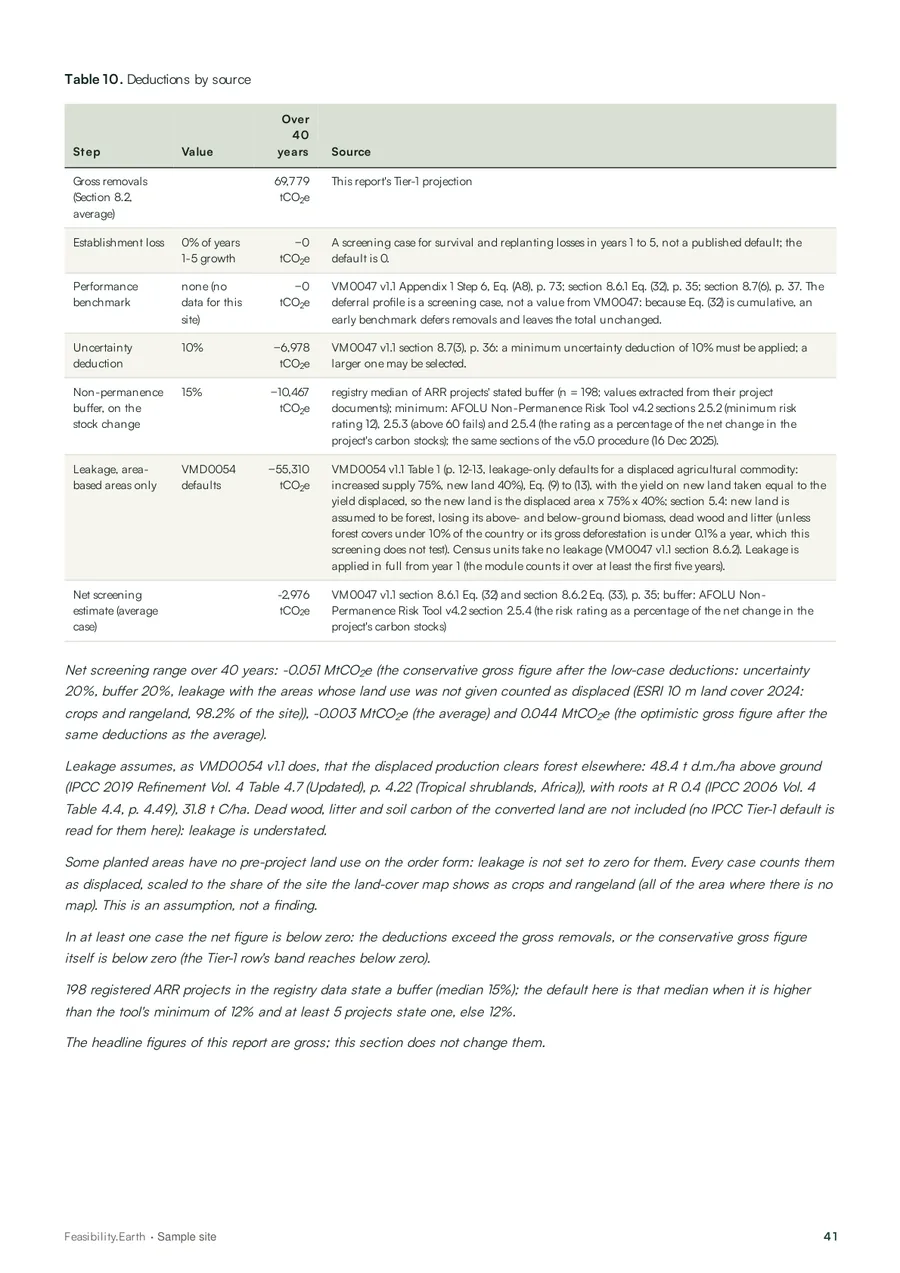 Gross to netEvery deduction with its source
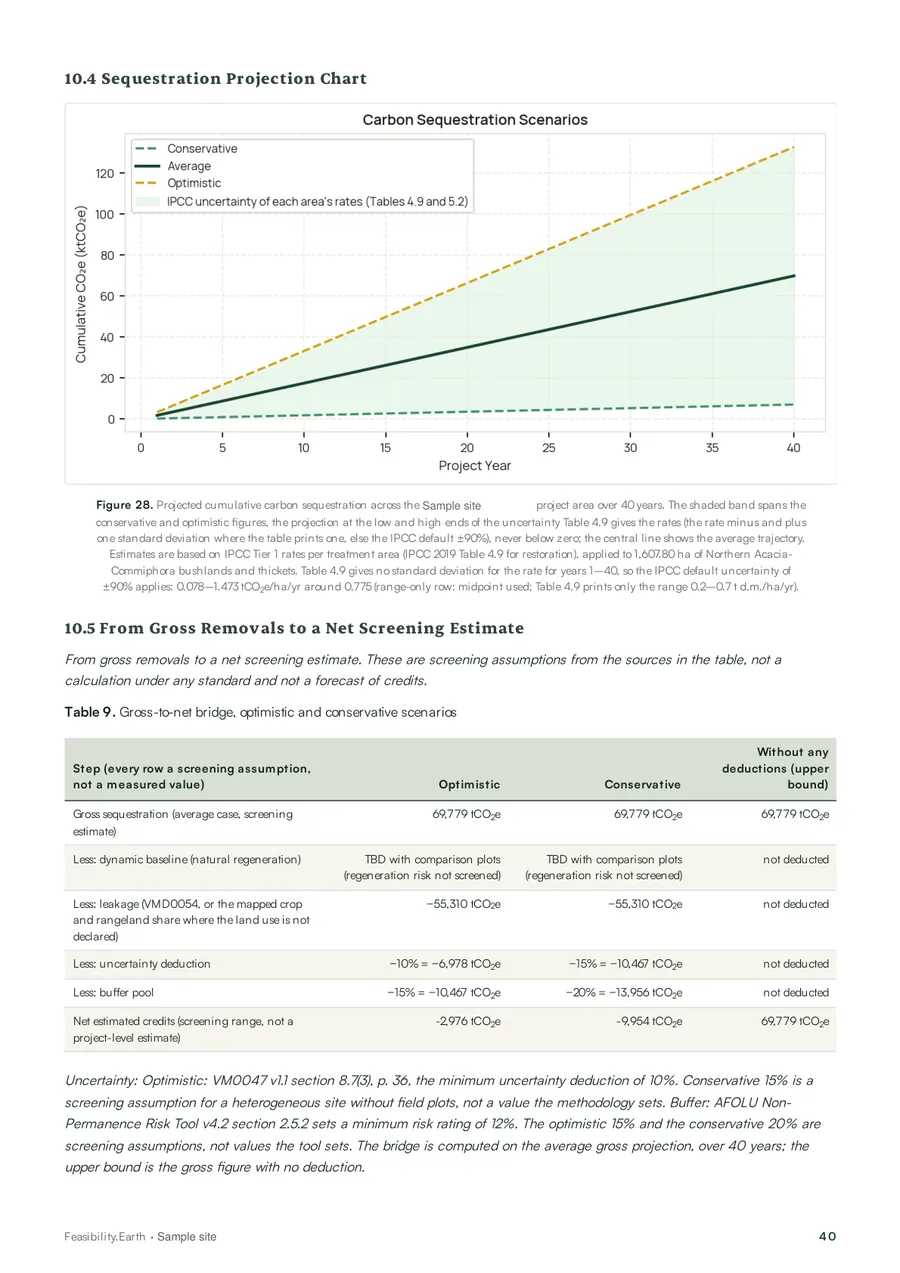 Carbon projectionConservative, average and optimistic cases
The baseline: VM0047's dynamic performance benchmark
Credits are only for removals the project causes. Land left alone may regrow on its own, so that regrowth has to be subtracted. VM0047 has two quantification approaches:
- Area-based approach. The project area is compared with matched control plots outside it, observed with remote sensing over the same period. Growth that also happens on the control plots is not credited. This is the dynamic performance benchmark, and it also serves to show additionality.
- Census-based approach. For projects where individual trees are counted, such as scattered planting on farms, removals are measured per tree.
The benchmark is measured during monitoring, from data that does not exist before the project starts. A feasibility study cannot calculate it. What a study can do is look at forest-cover history and land cover today and flag where natural regrowth is likely, which is a risk to the net figure.
Leakage: the deduction that surprises people
When trees go onto land that was used for grazing, crops or fuelwood, that use usually moves somewhere else, and the emissions it causes there count against the project. VM0047 uses the module VMD0054 to estimate ARR leakage.
In the example, leakage was the largest deduction at 79% of gross (55,310 tCO2e), because the order form did not say how the land is used today. The report then counts the planted area as displaced in proportion to the share of the site the land-cover map shows as crops and rangeland (98.2% here), and applies the VMD0054 default values. A site on abandoned or degraded land with no current use would lose much less. Agroforestry that keeps the crops in place can also reduce displacement; see agroforestry carbon credits.
Uncertainty
Every estimate of tree carbon has a margin of error. Standards deduct for it so that credits are not over-issued. For the ex-ante estimate made before the project starts, VM0047 requires an uncertainty deduction of at least 10%; a project may choose more. During monitoring the deduction follows from how precise the measurements turn out to be, so the final figure is only known later. Our screening applies the 10% minimum and shows it as its own line.
The carbon estimate itself also carries uncertainty. IPCC Tier 1 growth rates are averages for an ecological zone, so the report gives conservative, average and optimistic cases. That spread is often wider than the deduction.
The non-permanence buffer (NPRR)
Trees can burn, die in a drought or be cut. To cover such reversals across the whole registry, each nature-based project deposits a share of its credits into a pooled buffer account. Under the VCS Program the share comes from the AFOLU Non-Permanence Risk Tool, which scores internal risks (such as project management and finance), external risks (such as land tenure and community engagement) and natural risks (such as fire and drought).
The real buffer is set at validation. Our screening uses 15%, the median of registered ARR projects, and the report says so. Projects with secure tenure and low fire risk can do better; projects with disputed land can do much worse.
Timing: when the credits arrive
Young trees grow slowly, so most removals come years after planting. Credits are issued only after each verification. A feasibility report should show the removals over time and when credits can be issued, not only the total. Credits that are postponed arrive later; they do not vanish. For the full sequence of steps, see the project development pathway.
How a feasibility study handles gross to net
In a Feasibility.Earth study the headline is the gross estimate, and the net range has its own section with every deduction and its basis. That way you can see what drives the result and replace an assumption when you have better data, for example a buffer score after a risk assessment.
Frequently asked questions
Gross removals are the carbon the trees are expected to take up. Net is what is left after the deductions the standard requires: the baseline (what would have grown anyway), leakage (emissions caused elsewhere by displacing the previous land use), an uncertainty deduction and a contribution to the non-permanence buffer. Only verified net removals can be issued as credits.
Under the Verra VCS Program, nature-based projects deposit a share of their credits into a pooled buffer account. The pool covers reversals such as fire or illegal felling across all projects. The share is set with the AFOLU Non-Permanence Risk Tool from the project’s risk score. Buffer credits cannot be sold by the project.
Leakage is an increase in emissions outside the project caused by the project. In tree planting it usually means grazing, cropping or fuelwood collection that moves elsewhere when the land is planted. VM0047 handles ARR leakage through the module VMD0054. In our sample study leakage took 79% of gross removals, based on the VMD0054 default values for displaced land use.
In the VM0047 area-based approach, the project’s tree growth is compared against matched control plots outside the project that are monitored over the same period with remote sensing. Growth that also happens on the control plots is not credited. Because it is measured during monitoring, a feasibility study cannot calculate it in advance.
For the ex-ante estimate, VM0047 requires at least 10%, and a project may choose more. During monitoring it depends on the measurement precision the project achieves, so the final figure is only known later. Our screening applies the 10% minimum and shows it as its own line, so you can replace the assumption.
No. Credits that are postponed arrive later, not never. A feasibility report should show when credits are expected to be issued, not only the total, because the timing drives the cash flow.