For NGOs
Test your restoration programme against a carbon methodology first
Carbon credits for NGOs start with a plain question: does the land and the planting plan fit a tree-planting methodology at all? A desktop screen following VM0047 tells you, with the net figure, before you tell a single donor about carbon.
Why test before you fundraise on carbon
Restoration carbon finance is attractive to NGOs: credit revenue could pay for planting and maintenance after the grant ends. The risk is building a funding story on carbon that the land cannot deliver. A programme on land that was forest a few years ago, or one that mostly replaces farming, can lose most of its expected credits to eligibility rules and deductions.
A desktop screen checks that before you put a number in a proposal. It follows VM0047, Verra's methodology for afforestation, reforestation and revegetation (ARR). The carbon feasibility study guide explains what a study covers.
- Eligibility Check$500 · 2–3 days
- Full study$7,500 · 5 days
- ScopeRestoration, ARR, agroforestry
- ReviewEvery report, by a specialist
How it works for an NGO programme
Map the programme area
Upload a KML or KMZ boundary on app.feasibility.earth and give each zone a role: restoration planting, agroforestry, preservation or reference. Add species if you know them, a start year, and how the land is used today. About 15 minutes.
Method check
Before you pay, you learn whether the programme is tree planting on land without forest. Protecting standing forest (REDD+), soil carbon and blue carbon are out of scope for now.
Eligible area
Forest in 2000 and loss in the last 10 years (Hansen Global Forest Change), built-up land (GHSL), water and wetland (JRC), slopes over 30° (NASADEM) and recent conversion of native vegetation are removed.
Carbon and deductions (full study)
Removals over 40 years in conservative, average and optimistic cases from IPCC 2019 Refinement Tier 1 rates, then uncertainty, a non-permanence buffer and leakage. If you give no species, a shortlist comes from registered ARR projects in the same ecoregion.
Recommendation
Proceed or not, the open risks and the work still needed. That tells you whether carbon belongs in your next proposal, and with what caveats.
Agroforestry and community planting
Many NGO programmes plant trees with farmers rather than in closed plantations. That is within scope. Agroforestry zones are screened with the same IPCC Tier 1 rates for the site's ecological zone, and where farming continues under the trees, the base case carries no leakage for that zone, because nothing is displaced. A low case treats the mapped cropland share as displaced, so you see the range.
History still decides eligibility. In an anonymised agroforestry screening in a montane landscape in western Uganda, near the Albertine Rift, the boundary covered about 4,070 ha but only 16.3% (about 664 ha) was eligible, because most of the land already met the forest definition. The eligible part had strong growth rates; the 40-year average case was about 212,300 tCO2e gross. The programme's carbon case rested on one hectare in six. Read agroforestry carbon credits for what changes in the study.
Donor credibility: gross, net and the sources
Donors and their advisers will want to know how a carbon figure was made. The report shows gross and net side by side and names the source of every number. In the anonymised East African sample study, 69,779 tCO2e gross over 40 years became a net screening estimate of −2,976 tCO2e after a 10% uncertainty deduction (the VM0047 minimum for ex-ante estimates), a 15% buffer (the median of 198 registered ARR projects in our registry data) and leakage of 55,310 tCO2e (79% of gross) from displaced land use. A donor would rather hear that before the trees go in than after.
Quoting the net figure, with its caveats, is a stronger position than quoting gross and correcting it later. The gross vs net guide explains each deduction, and additionality for tree-planting projects covers a question donors and auditors will ask: would the trees be planted without carbon money?
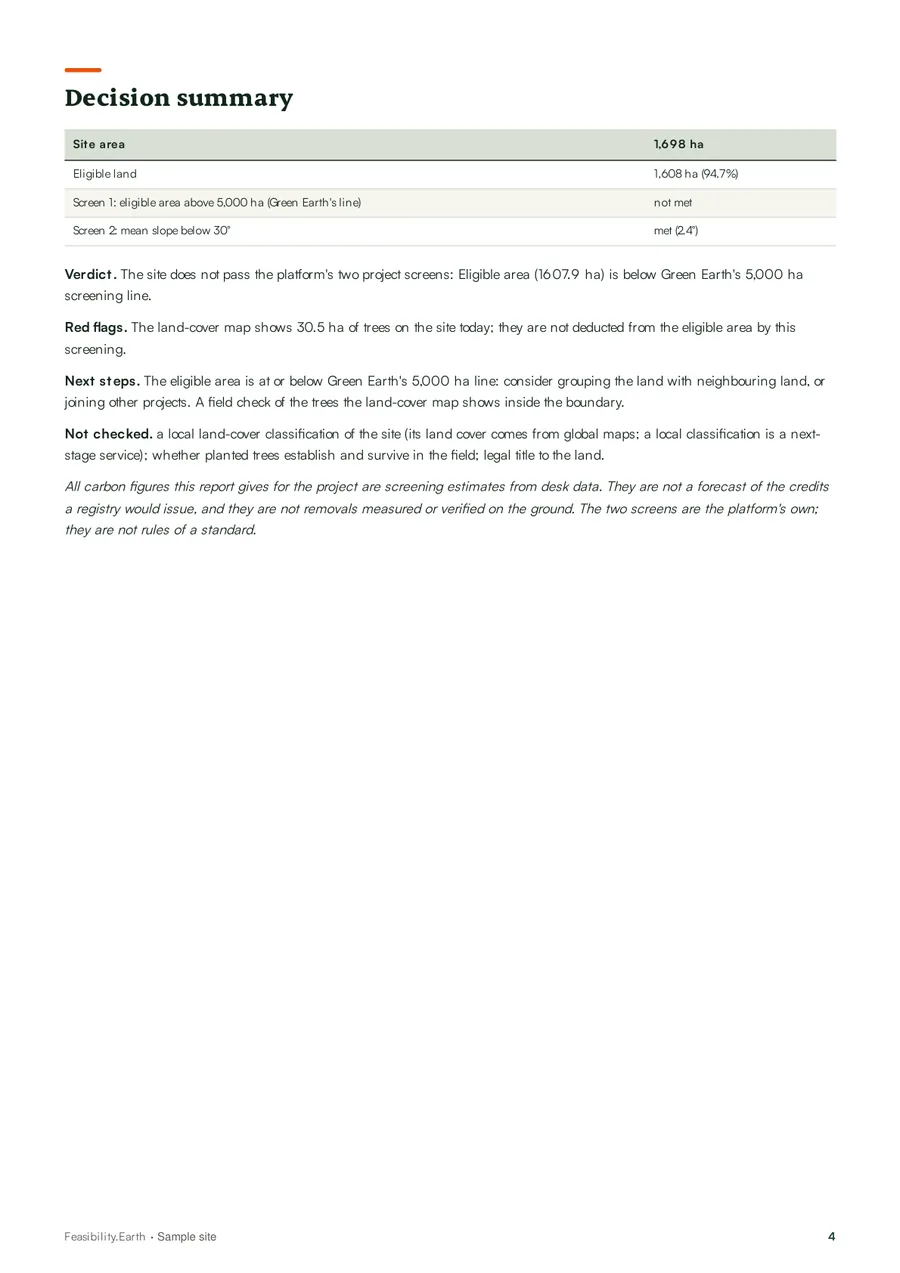 Decision summaryBoth screens, red flags and next steps on one page
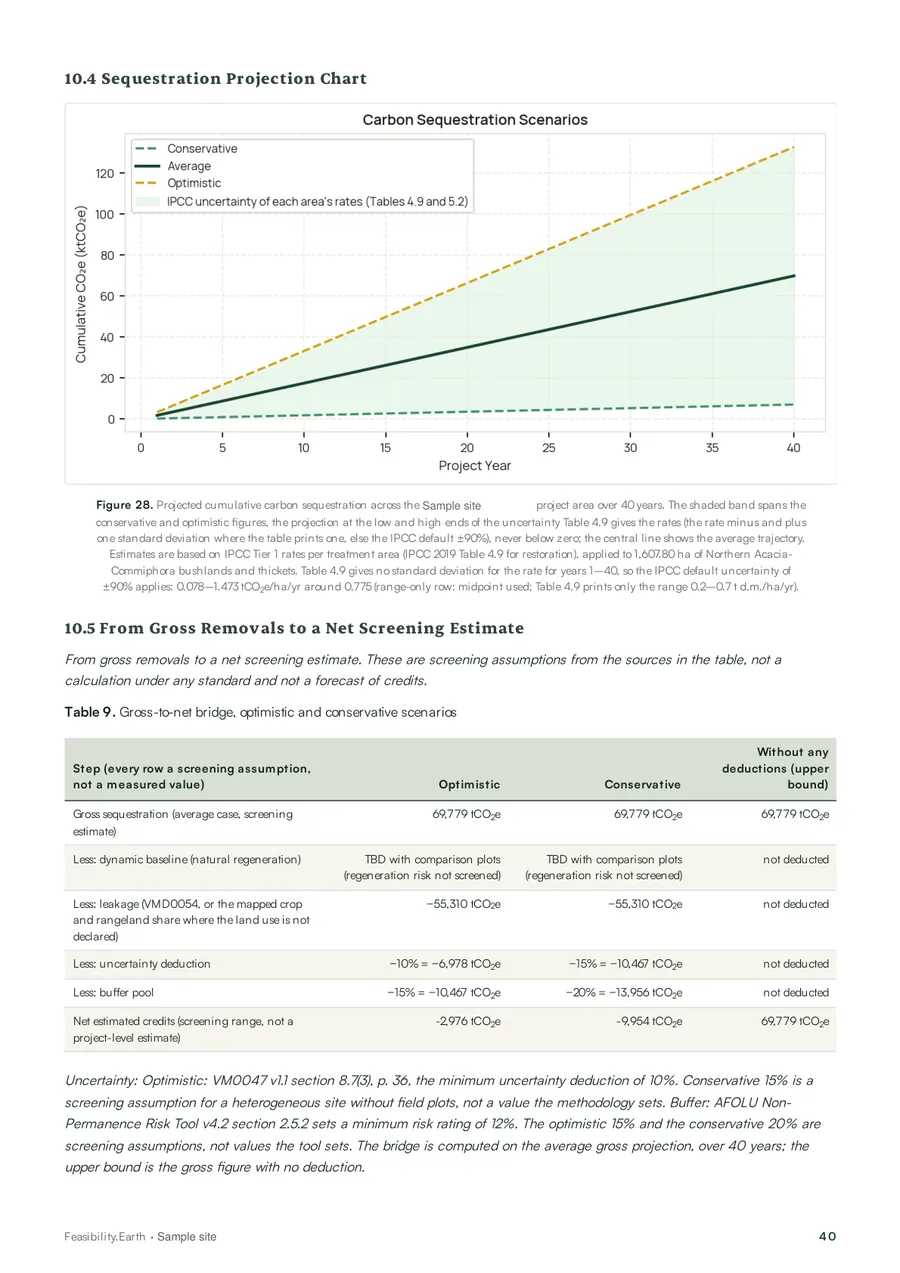 Carbon projectionConservative, average and optimistic cases
Limits
A screening can also tell you that carbon is the wrong tool for a programme. Restoring degraded forest that still counts as forest (which we do not screen, and which VM0047 allows only where the forest has not been managed for wood products in the past ten years), planting on land cleared in the last few years, or a plan whose credits mostly disappear into leakage may still be worth funding for biodiversity, water or livelihoods, but on grant money rather than credit revenue. Knowing that before you write the proposal saves you from promising donors something the land cannot deliver, and lets you put carbon only where it fits: often one part of a larger programme area rather than all of it.
Prices and refund terms are on the pricing page. For a project you intend to run for decades, the project development guide sets out the stages after the screening.
Frequently asked questions
It can, if the programme plants or restores trees on land that has not been forest recently and the project is registered under a methodology such as Verra's VM0047, then validated, monitored and verified. Many restoration programmes do not qualify, or qualify on only part of their land, which is why it is worth testing before you fundraise on carbon.
Yes, agroforestry is within the scope we screen, as tree planting on land without forest. Where farming continues under the trees, the screening's base case carries no leakage for that zone; a low case treats the mapped cropland share as displaced.
Under our terms the report is your property once paid for, so you can share it. It names every dataset and assumption, shows gross and net removals separately and is reviewed by a specialist before release. Be clear with donors that it is a desktop screening following VM0047, not a validation, a verification or a promise of credits.
No. It is a desktop feasibility screening. Certification means validation and verification by an accredited body under a registry such as Verra. The screening tells you whether that route looks worth starting.
The Eligibility Check is $500 and is delivered in 2–3 business days from a complete intake; it is not refunded once work starts. The Full Feasibility Study is $7,500 in 5 business days; if it concludes the land does not qualify, 50% of the fee is refunded.