Guide · Agroforestry under VM0047
Agroforestry carbon credits: what counts and how to test feasibility
Trees planted with crops or livestock can earn carbon credits as an ARR activity under VM0047. The carbon is smaller per hectare than a closed forest, but leakage and community support can work in your favour. This guide sets out what counts and what a feasibility study needs to know.
How agroforestry fits ARR and VM0047
Agroforestry means growing trees on the same land as crops or livestock: parkland trees over millet, fruit and timber trees in alleys between crops, shade trees over coffee or cocoa, or trees on grazing land (silvopasture). Where the trees are planted on land that is not forest, the activity is ARR (afforestation, reforestation and revegetation), and VM0047 is the Verra methodology that applies.
The same eligibility rules apply as for any reforestation project: the land must not be forest at the start and must not have been cleared of native ecosystems in the 10 years before. Farms with scattered existing trees need care, because satellite land cover can read them as forest.
What counts for carbon credits
- Trees count. Above-ground woody biomass is the core of the estimate.
- Crops and grass do not. Annual crops are harvested, so they are not a lasting carbon store.
- Soil carbon is not in our estimate. It may rise under trees, but it is not part of our screening.
- Existing trees are baseline. Only growth that the project causes is credited.
Because VM0047 offers a census-based approach for projects where trees are counted, scattered planting across many farms can be quantified tree by tree rather than by area.
Agroforestry vs a closed plantation
| Agroforestry | Closed planting | |
|---|---|---|
| Trees per hectare | Low to medium | High |
| Carbon per hectare | Lower | Higher |
| Leakage | Can be lower if crops or grazing continue | Higher if crops or grazing are displaced |
| Farmer income before credits | Crops continue | Land taken out of production |
| Area needed for viable scale | Larger, often many farms | Smaller |
| Monitoring | Many small plots, often a census | Fewer, larger stands |
Whether the lower carbon per hectare is offset by lower leakage depends on the site. That is what the gross-to-net table in a study shows.
What a feasibility study needs from you
A boundary per zone
A KML or KMZ with each farm or zone as its own polygon. Mixing agroforestry and closed planting in one polygon blurs both estimates.
A role and treatment per zone
Planting, agroforestry, preservation or reference, and what will be planted at what density. If you do not know the density yet, say so; the report marks the estimate as an upper bound.
Species
Name them if you know them. Fruit, timber and nitrogen-fixing trees grow at very different rates, and the study screens each against the site's climate and checks invasive status.
Current land use
What happens on the land today. It drives leakage, and it is one of the things to confirm on the ground.
The anonymised sample study shows what happens without that information. Its boundary was one area with no treatment, species or land use given, so the report projected carbon on the whole eligible area at the IPCC regrowth rate, called the result an upper bound, and counted the mapped crops and rangeland as displaced. Its report pages show how that carries through to the carbon estimate:
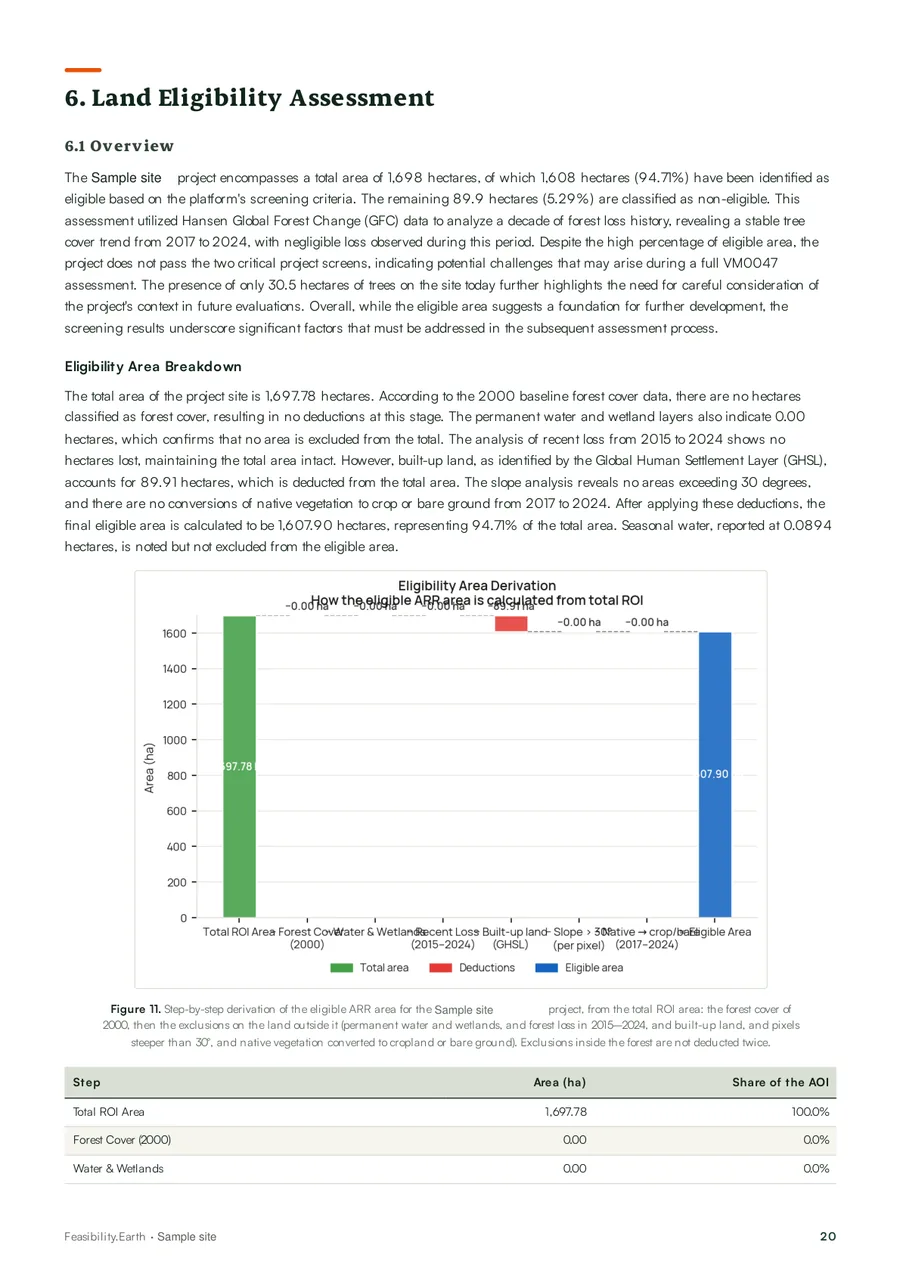 Eligible areaThe exclusion cascade, pixel by pixel
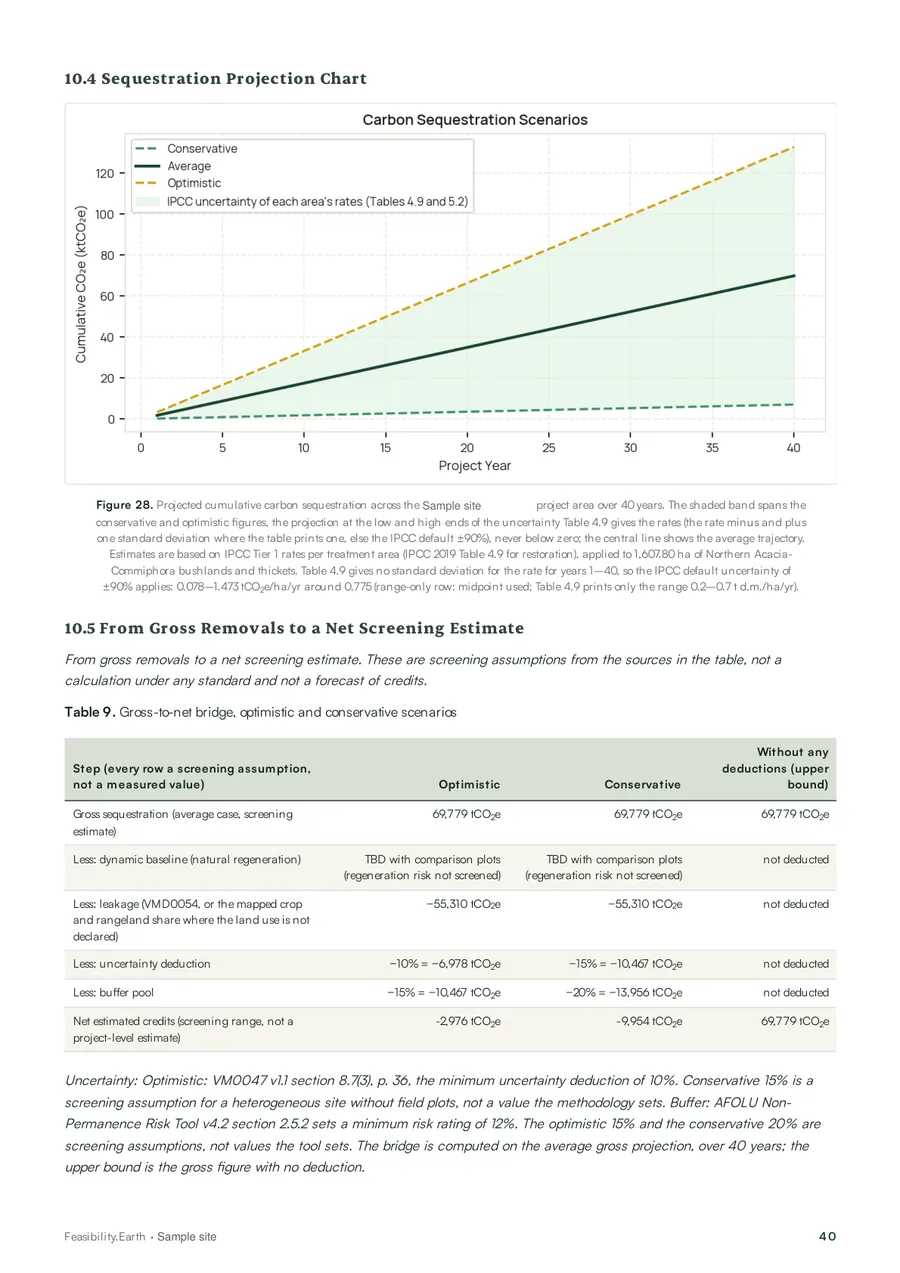 Carbon projectionConservative, average and optimistic cases
Read the carbon feasibility study guide for the full process, or start with a $500 eligibility check.
Where agroforestry projects struggle
Frequently asked questions
Yes. Planting trees on cropland or pasture is an ARR activity, and under the Verra VCS Program it can be developed with the methodology VM0047. The credits come from the carbon in the trees, not from the crops or the livestock.
Our screening estimates carbon in the trees only. Soil carbon gains under agroforestry are real on many sites, but they are harder to measure and are not part of our estimate.
There is no single figure; it depends on the system. Parkland trees may stand at a few dozen per hectare, alley cropping and woodlots at several hundred. Removals scale with the number of trees and their growth, so the planting density per zone is one of the most important inputs to a study.
It can be. Leakage counts emissions from activities that move elsewhere because of the project. If farmers keep growing crops or grazing between the trees, less activity is displaced than when a field is converted to a closed plantation. The study estimates leakage with the VMD0054 module and shows it as its own line.
Yes, smallholder agroforestry is usually developed as a grouped project. For a feasibility study, give each farm or zone as its own polygon in the KML with its role and planned trees per hectare.